Scroll To Top
Scroll To Top

Jerusalem — Jewish Quarter Photo Gallery

Click the title to view map


Jerusalem Overview

Introduction

The Cardo

Nestled in the southeastern corner of Jerusalem’s Old City, the Jewish Quarter blends ancient history with the life of a modern neighborhood. Narrow stone streets lead visitors past archaeological excavations, restored synagogues, bustling plazas, and homes built upon layers of more than three thousand years of history. Although much of the quarter was destroyed during the fighting of 1948, it was carefully rebuilt after Israel regained the Old City in 1967, preserving both its historic character and its role as the heart of Jewish life within Jerusalem’s walls.

For Bible students, the Jewish Quarter offers a unique window into Jerusalem’s past. Here you can walk the remains of the Byzantine Cardo, explore the broad wall built during the reign of King Hezekiah, visit the Hurva Synagogue, and descend beneath modern streets to discover homes and public buildings from the days of the First and Second Temples. Together these sites reveal how Jerusalem has grown, been destroyed, and been rebuilt through the centuries, making the Jewish Quarter one of the most fascinating places to explore in the Old City.

Slide Presentation Major Events

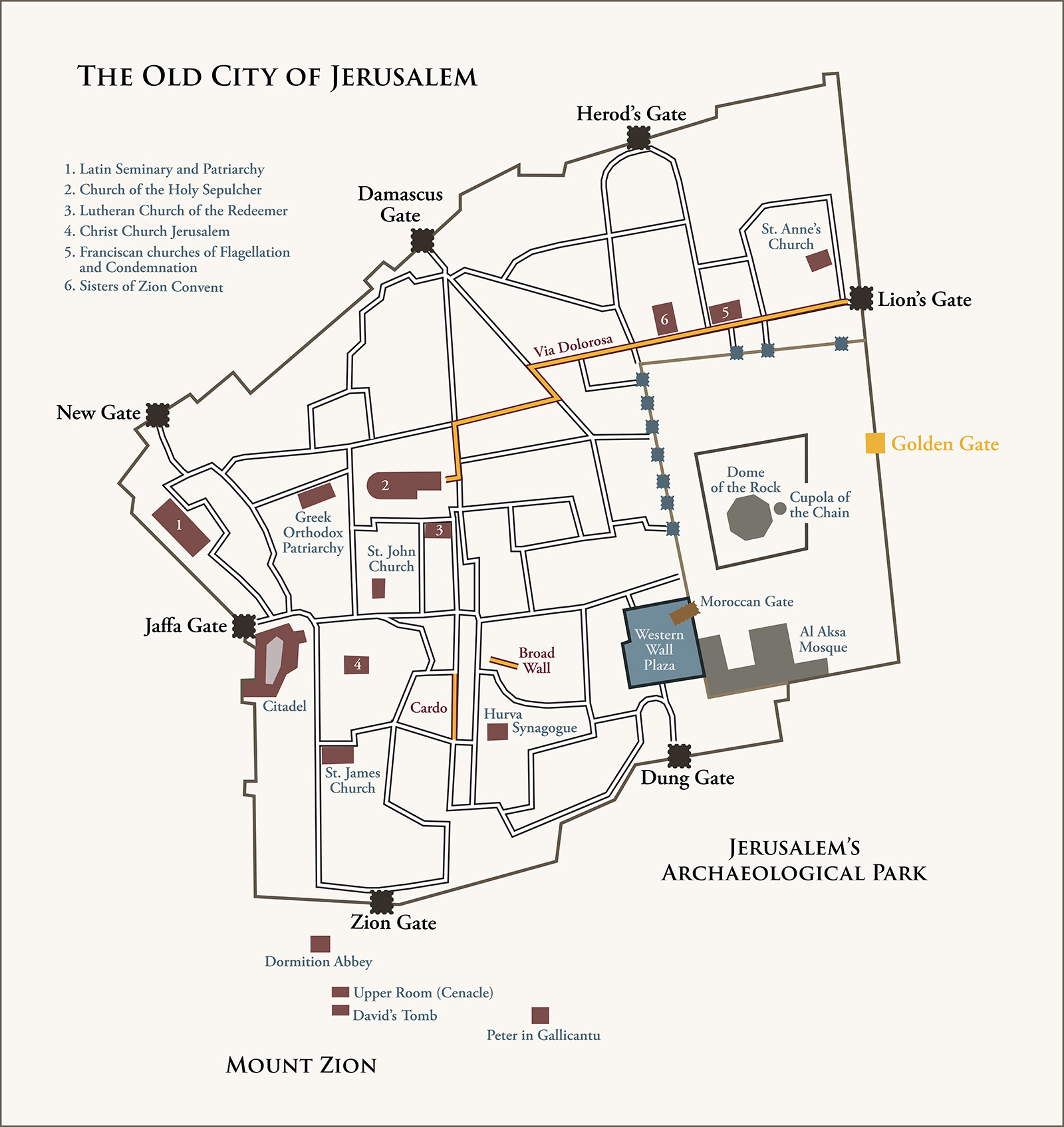
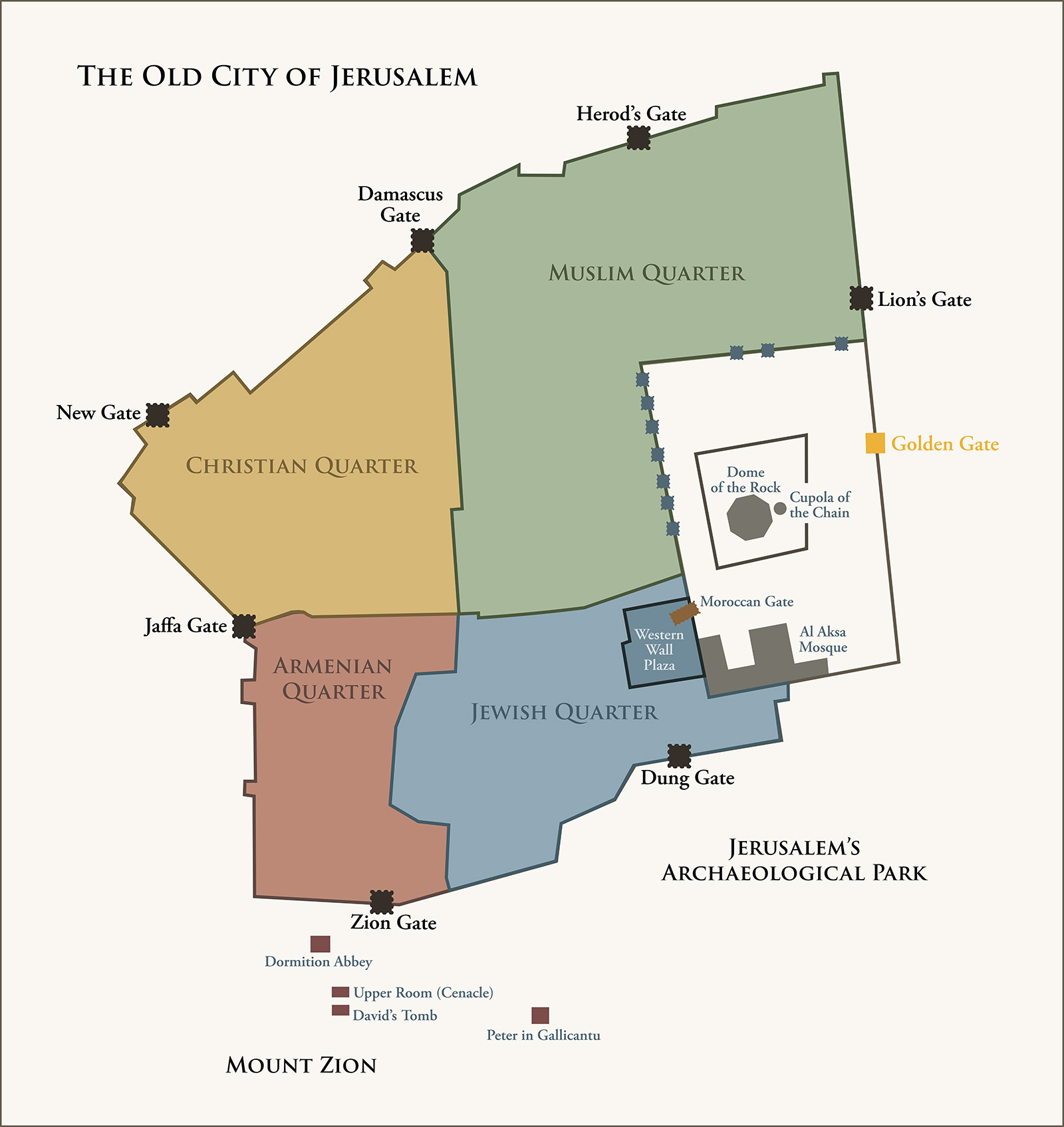
Click the map to show or hide the quarters of the Old City

Map

Major Events at Jerusalem

The Jerusalem Cardo

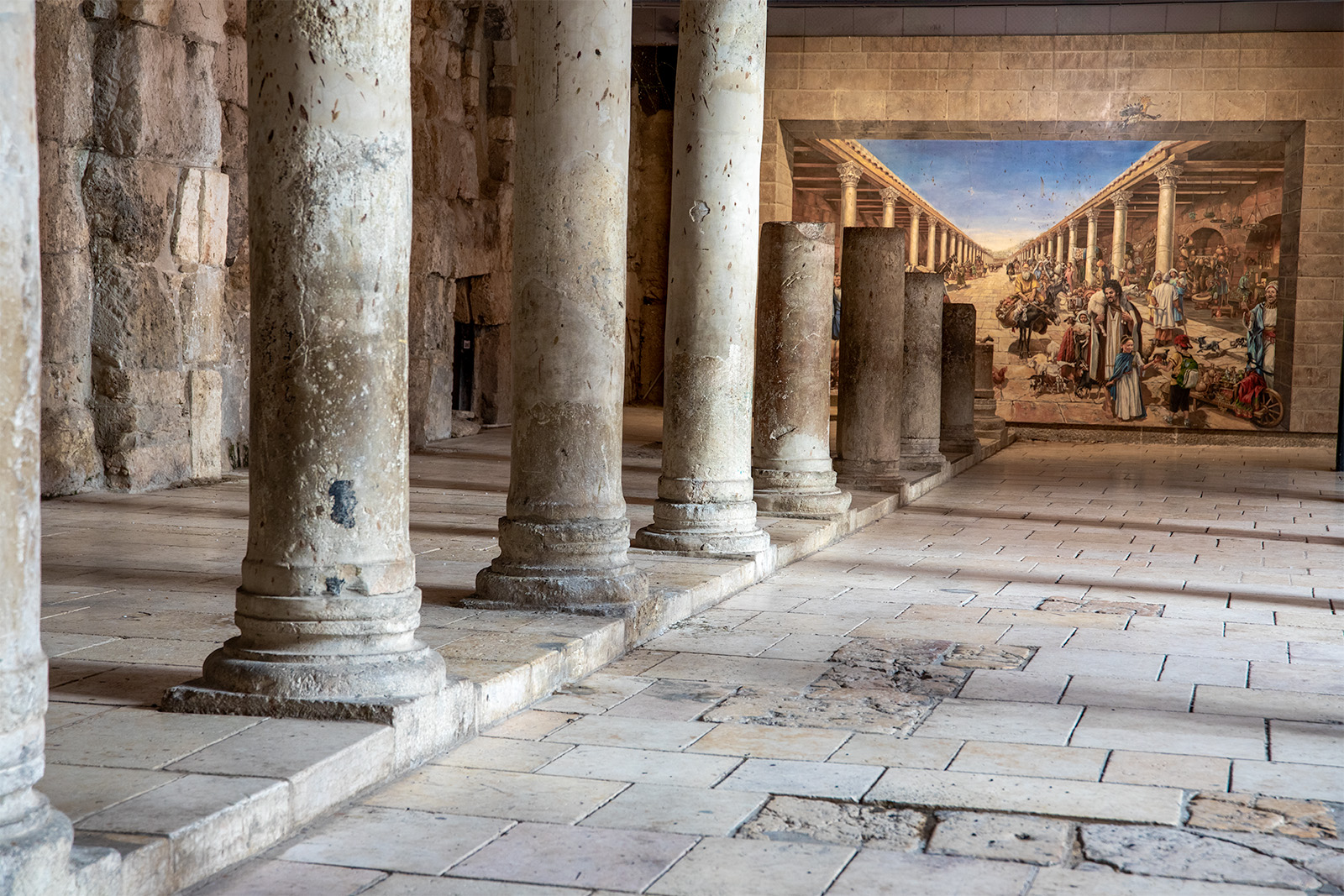
This modern mural reconstructs the Cardo as it may have appeared during the Byzantine period, when Jerusalem was a major Christian city of the eastern Roman Empire. A broad paved roadway ran between rows of columns, with covered walkways and shops lining the route. Merchants, pilgrims, residents, and animals would have made the Cardo one of the busiest thoroughfares in the city.

The Cardo is prominently depicted on the sixth-century Madaba Mosaic Map of Jerusalem, which shows the colonnaded avenue running through the heart of the city.

The Jerusalem Cardo

Excavated and partially reconstructed remains of the Cardo preserve the appearance of the great colonnaded street that crossed Byzantine Jerusalem. Columns supported a roof over the pedestrian walkway, while shops opened along its side. The uncovered central roadway would have carried much of the traffic through this part of the city.

Although Jerusalem had a Roman cardo centuries earlier, much of what visitors see here belongs to the major expansion of the street during the Byzantine period, particularly in the sixth century under Emperor Justinian.

The Jerusalem Cardo

This modern mosaic depicts merchants and customers engaged in the kinds of commercial activity that once characterized the Cardo. Pottery, food, textiles, household goods, and other merchandise would have been sold from shops and stalls lining the busy street. At the center, a glassblower creates a decorative panel from pieces of glass and gold, inspired by a similar panel discovered in an ancient mansion at Caesarea.

The Cardo was more than a transportation route. With its covered walkways and rows of shops, it served as one of Byzantine Jerusalem’s principal commercial and social centers, where residents and pilgrims alike gathered to buy, sell, and conduct daily business.

The Jerusalem Cardo

A portion of the Cardo continues beneath the modern buildings of Jerusalem’s Jewish Quarter. The covered passage follows the course of the ancient thoroughfare and today contains shops and galleries, recalling the commercial function the street performed many centuries ago.

The modern Jewish Quarter stands at a substantially higher level than parts of ancient Jerusalem. Excavations beneath it have revealed remains from several periods of the city’s long history, including this section of the Byzantine Cardo.

The Jerusalem Cardo

A row of columns marks the excavated course of the Byzantine Cardo in the Jewish Quarter. The columns once formed part of a colonnade separating the broad central street from a covered pedestrian walkway lined with shops.

The surviving pavement, column bases, and architectural remains help visitors visualize the scale of the avenue. In its Byzantine form, the Cardo extended southward through the city and became one of the defining features of sixth-century Jerusalem.

The Jerusalem Cardo

The Cardo excavations exposed more than the Byzantine street itself. Archaeologists digging through this area encountered structures and architectural remains belonging to earlier periods of Jerusalem’s history, preserved beneath the later city.

This arched structure illustrates an important feature of Jerusalem archaeology: successive generations built, rebuilt, and sometimes raised the level of the city, leaving earlier remains buried beneath later construction. The Cardo excavations therefore provide a window into several layers of Jerusalem’s past.

Hurva Synagogue

The great dome of the Hurva Synagogue rises above the Jewish Quarter of Jerusalem’s Old City. The present building is a reconstruction of the synagogue completed here in 1864, which became one of Jerusalem’s most prominent synagogues and an important center of Ashkenazi Jewish life.

The synagogue was destroyed during the fighting for the Jewish Quarter in 1948. After 1967, a single monumental arch was erected over the ruins as a memorial to the lost building. That arch was removed when reconstruction began in 2006. The synagogue was rebuilt to recreate its nineteenth-century appearance and rededicated in 2010. Its name, Hurva, meaning “ruin,” recalls an earlier synagogue on the site that had itself been destroyed.

Hurva Synagogue

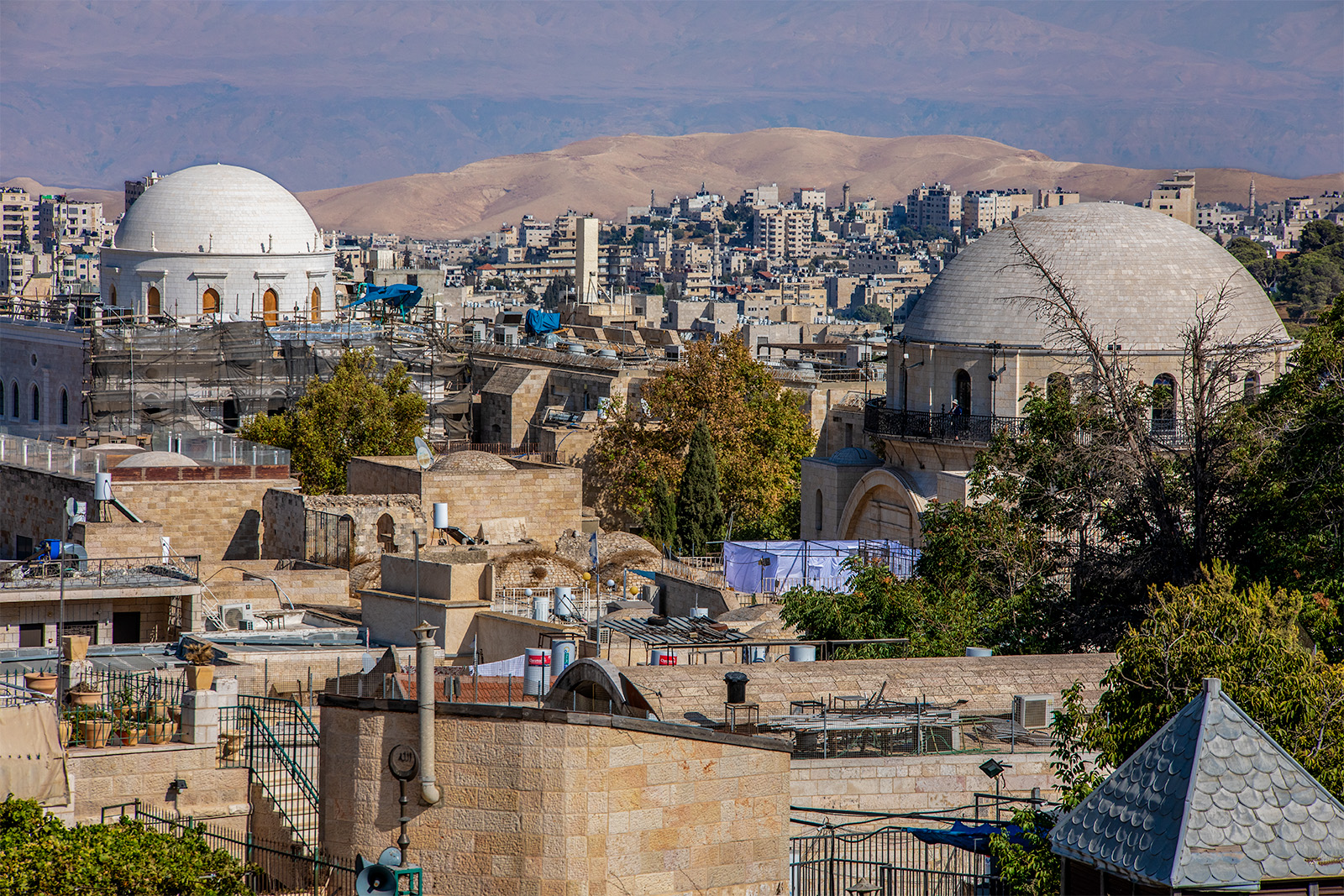
Seen from the Citadel near Jaffa Gate, the dome of the Hurva Synagogue (right) rises prominently above Jerusalem’s Jewish Quarter. Beyond the Old City, the landscape descends toward the Judean Wilderness, the Jordan Valley, and the country of Jordan in the distance.

The large white dome to the left is the reconstructed Tiferet Yisrael Synagogue, another important nineteenth-century synagogue of the Jewish Quarter. Completed in 1872, it was destroyed during the fighting for the Old City in 1948. After standing in ruins for decades, the historic synagogue has been reconstructed as part of the continuing restoration of the Jewish Quarter.

Huurva Synagogue

Hurva Square spreads out beside the Hurva Synagogue and forms one of the principal gathering places in Jerusalem’s Jewish Quarter. Shops, cafés, religious institutions, and pedestrian streets surround the open plaza, making it a lively center for residents and visitors. The square itself was developed after 1967 on an area heavily damaged during the fighting for the Jewish Quarter in 1948.

Prominently displayed in the glass case is a modern reconstruction of the seven-branched menorah associated with the ancient Jerusalem Temple. Created by the Temple Institute, it recalls the menorah that once stood within the Temple and reflects the continuing importance of the Temple in Jewish history and religious tradition. Behind the square (center) rises the white dome of the reconstructed Tiferet Yisrael Synagogue, also visible in Photo 2. Another major landmark of the Jewish Quarter, the synagogue was destroyed in 1948 and later reconstructed.

Hurva Synagogue

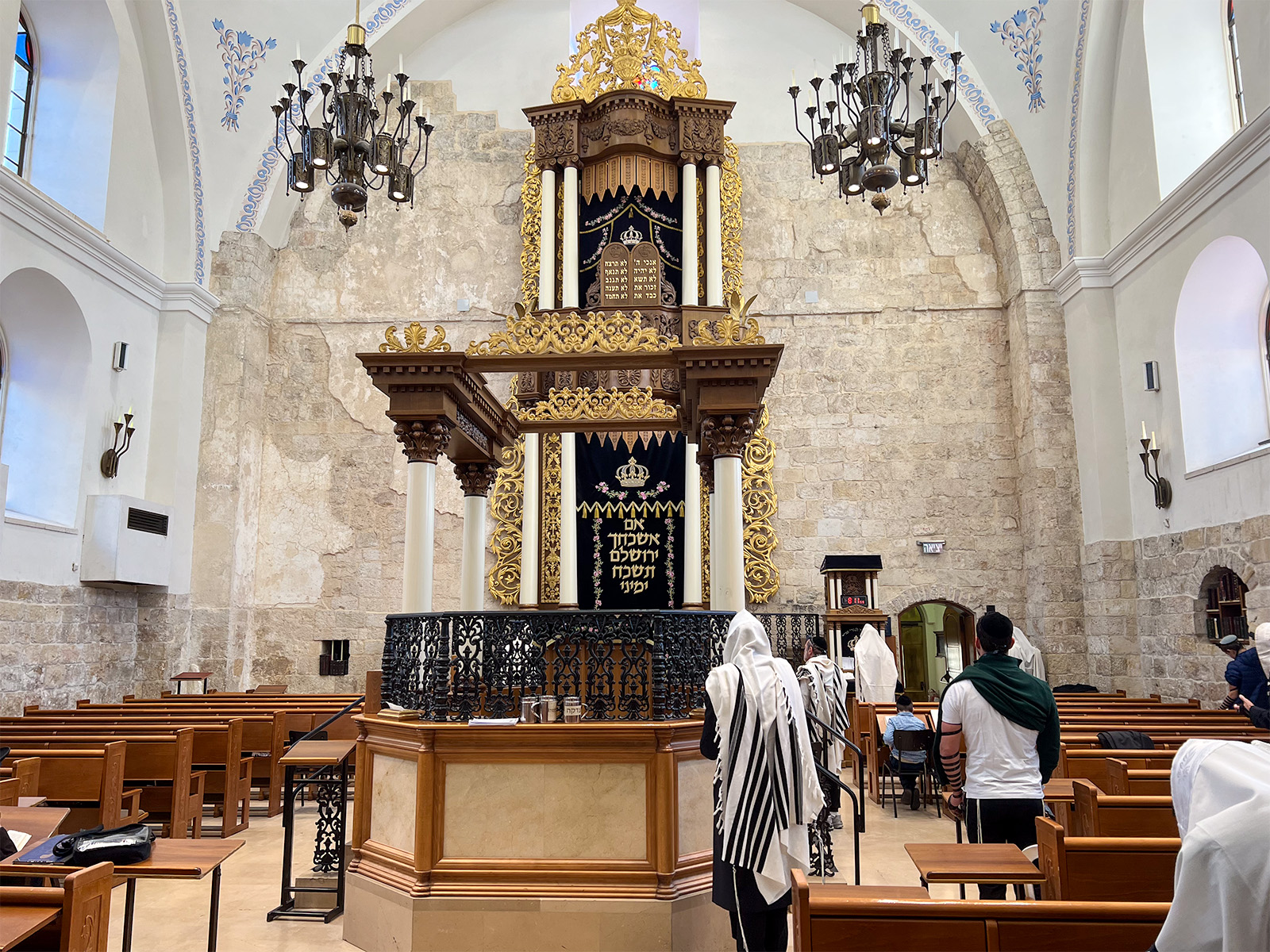
The reconstructed interior recalls the appearance of the nineteenth-century Hurva while once again serving as an active Orthodox synagogue. The focal point is the ornate Torah ark, or Aron Kodesh, on the eastern wall, where the Torah scrolls are kept. The raised platform in the center is the bimah, from which the Torah is read during worship.

Embroidered on the curtain of the Torah ark are the Hebrew words of Psalm 137:5: “If I forget thee, O Jerusalem, let my right hand forget her cunning” (KJV)—that is, lose its skill. The words express the centuries-old Jewish attachment to Jerusalem and are especially meaningful here in a synagogue that was destroyed in 1948 and eventually rebuilt. The restored Hurva was rededicated in March 2010, more than sixty years after its destruction.

Hurva Synagogue

This architectural model near the synagogue entrance shows the Hurva with its massive central dome and monumental façade. The model helps visitors appreciate the scale of a building that is difficult to see in its entirety from the narrow streets and confined spaces of the Jewish Quarter.

For decades after 1948, the Hurva remained a ruin, with a single reconstructed arch marking the site. Eventually the decision was made to recreate the nineteenth-century synagogue rather than replace it with an entirely modern design. Reconstruction began in 2006 and was completed in 2010.

Hurva Synagogue

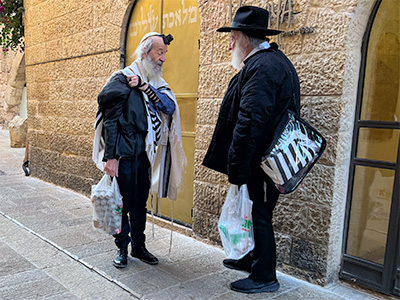
Two Jewish men pause for conversation after shopping at one of the stores surrounding Hurva Square. Scenes such as this reflect the everyday character of the Jewish Quarter, where synagogues, homes, schools, restaurants, and small shops occupy the same network of narrow streets and courtyards.

The setting also illustrates the Hurva’s place within the neighborhood. It is not simply a historic monument but an active synagogue standing at the center of a living Jewish community.

The Broad Wall

The Broad Wall is part of a massive fortification built around Jerusalem during the late eighth century BC, generally associated with the reign of King Hezekiah. Approximately 23 feet (7 meters) wide, the wall strengthened the defenses of the city as Jerusalem expanded onto the Western Hill and faced the growing threat of the Assyrian Empire..

The wall’s construction may be reflected in Isaiah 22:10, which describes the people of Jerusalem tearing down houses to strengthen the city wall. Archaeological evidence indicates that buildings in the path of the new fortification were indeed demolished as the wall was constructed.

The Broad Wall

This plaque stands beside the excavated Broad Wall in Jerusalem’s Jewish Quarter. It identifies the fortification as part of the wall surrounding Jerusalem’s western hill during the reign of King Hezekiah in the late eighth century BC.

The Broad Wall was uncovered during excavations in the Jewish Quarter following the 1967 Six-Day War. Its discovery provided important archaeological evidence that Jerusalem had expanded well beyond the older City of David by Hezekiah’s time.

The Broad Wall

The exposed remains reveal the extraordinary width of the Broad Wall, which measured approximately 23 feet (7 meters) across. Its massive construction reflects the urgent defensive preparations undertaken in Jerusalem during the late eighth century BC, when the Assyrian Empire was advancing through the region.

The fortification is commonly associated with Hezekiah’s preparations for the invasion of the Assyrian king Sennacherib in 701 BC. The Bible records that Hezekiah “built up all the wall that was broken” and strengthened Jerusalem’s defenses in preparation for the Assyrian attack (2 Chronicles 32:5).

The Cardo

Three Jewish men pause in conversation along one of the narrow pedestrian streets of Jerusalem’s Jewish Quarter, near the Cardo and Hurva Synagogue. Scenes such as this reflect the character of the quarter today—not simply as a collection of archaeological and historic sites, but as a living neighborhood shaped by Jewish religious and community life.

Traditional dress, including the kippah (skullcap) worn by the men, is a common sight throughout the quarter. Modern homes, synagogues, shops, and schools stand alongside remains from Jerusalem’s ancient and medieval past, bringing together thousands of years of history within the streets of the Old City.

The 1948 War of Independence Memorial

The War of Independence Memorial commemorates the struggle for Jerusalem during Israel’s 1948 War of Independence. After the declaration of the State of Israel on May 14, 1948, fighting intensified between Jewish and Arab forces, while armies from neighboring Arab states entered the conflict. Jerusalem became one of the war’s principal battlegrounds, with Jewish neighborhoods under attack and supply routes to the city repeatedly cut.

The Jewish Quarter of the Old City endured particularly severe fighting. Its defenders were surrounded and increasingly isolated until the quarter surrendered to the Jordanian Arab Legion on May 28, 1948. Jewish residents were evacuated, defenders were taken prisoner, and much of the quarter was subsequently damaged or destroyed. The memorial preserves the memory of those who fought, suffered, and died during these events and of a Jewish community that would not return to the Old City until 1967.

The 1948 War of Independence Memorial

Historic photographs displayed inside the memorial document Jerusalem and the Jewish Quarter during the 1948 fighting. The images provide a vivid record of the people who lived through the siege—the defenders, residents, and families caught within the increasingly isolated quarter—and of the destruction that accompanied the battle.

Together, the photographs transform the events of 1948 from a chronology of battles into the experiences of ordinary people. They help visitors understand the difficult conditions under which the Jewish Quarter was defended and the human cost of its eventual surrender.

The 1948 War of Independence Memorial

A short film shown inside the memorial uses historic photographs and film footage to recount scenes from the 1948 fighting in Jerusalem. Images of combat, damaged neighborhoods, defenders, and civilians provide an unusually immediate view of the struggle for the city and the conditions faced by those living through it.

For visitors unfamiliar with the 1948 war, the presentation is especially illuminating. It places the fall of the Jewish Quarter within the larger battle for Jerusalem and helps explain why the events of 1948 remain such an important part of the historical memory of the restored Jewish Quarter today.